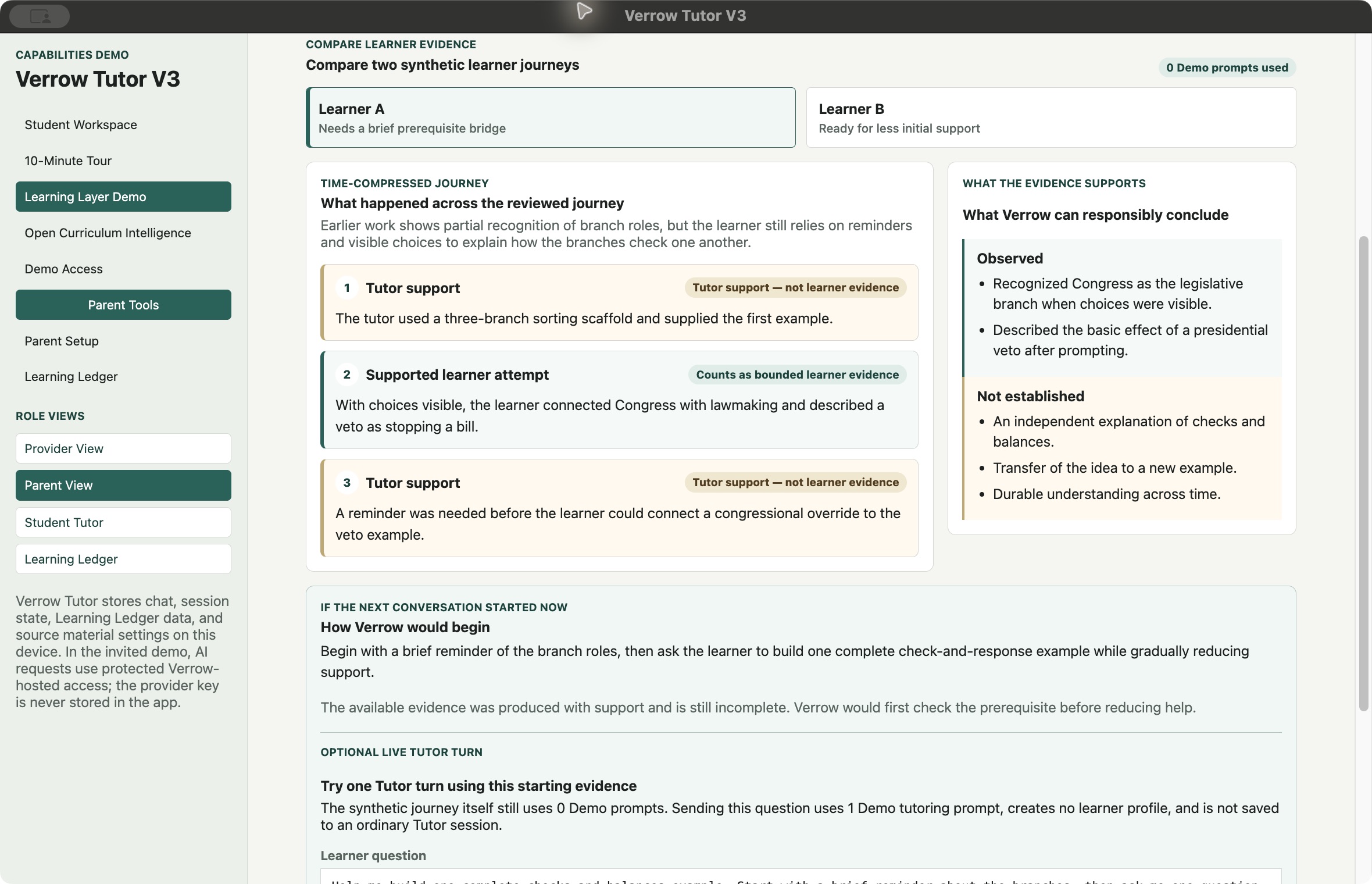
Begin with a brief bridge.
The learner reached the idea with visible choices and a reminder. Verrow would first reconnect the branch roles, then gradually reduce help.
Verrow Tutor V3 · Evaluation Candidate
Verrow turns the curriculum you trust into a governed tutoring experience a prospective partner can explore without a scripted presentation.
Students receive thoughtful guidance instead of copy-ready work. Parents and educators can see what happened. Curriculum teams can explore how privacy-protected evidence may help them ask better questions about their material.
Helping students think—not just answer.
Bring one representative lesson—or begin with the included Constitution sample—and experience Verrow at your own pace.
The Problem
The question is no longer whether AI belongs in education. It already does.
How do we make sure AI supports learning instead of replacing it?
Most AI tools make the answer easy and the learning hard to see. Parents do not know what was taught. Educators do not know where support was needed. Curriculum providers cannot tell whether their material still guided the experience.
Verrow was built to keep the learning—and the adults responsible for it—visible.
For Curriculum Providers
When a student gets stuck, someone has to bridge the gap between the lesson and the learner. That may be a parent, teacher, support team, outside resource, or increasingly, generic AI.
Verrow gives curriculum providers another option: guided learning grounded in their own material and educational approach.
Students get help where they need it. Families have more support using the curriculum they've chosen. And the curriculum remains at the center of the learning experience.
Who Verrow Is For
The same governed tutoring foundation serves students, the adults guiding them, and the organizations responsible for the curriculum.
What V3 Demonstrates
Verrow Tutor V3 brings curriculum authority, parent guidance, tutoring, student ownership, learning evidence, and curriculum review into one coherent evaluation experience.
V3 is an evaluation candidate, not a finished production deployment. The Tutor is live in the Demo; the Learning Layer and Curriculum Intelligence use reviewed synthetic examples to demonstrate capabilities that need longer evidence histories and governed partner data.
Curriculum Authority
Verrow is the guide.
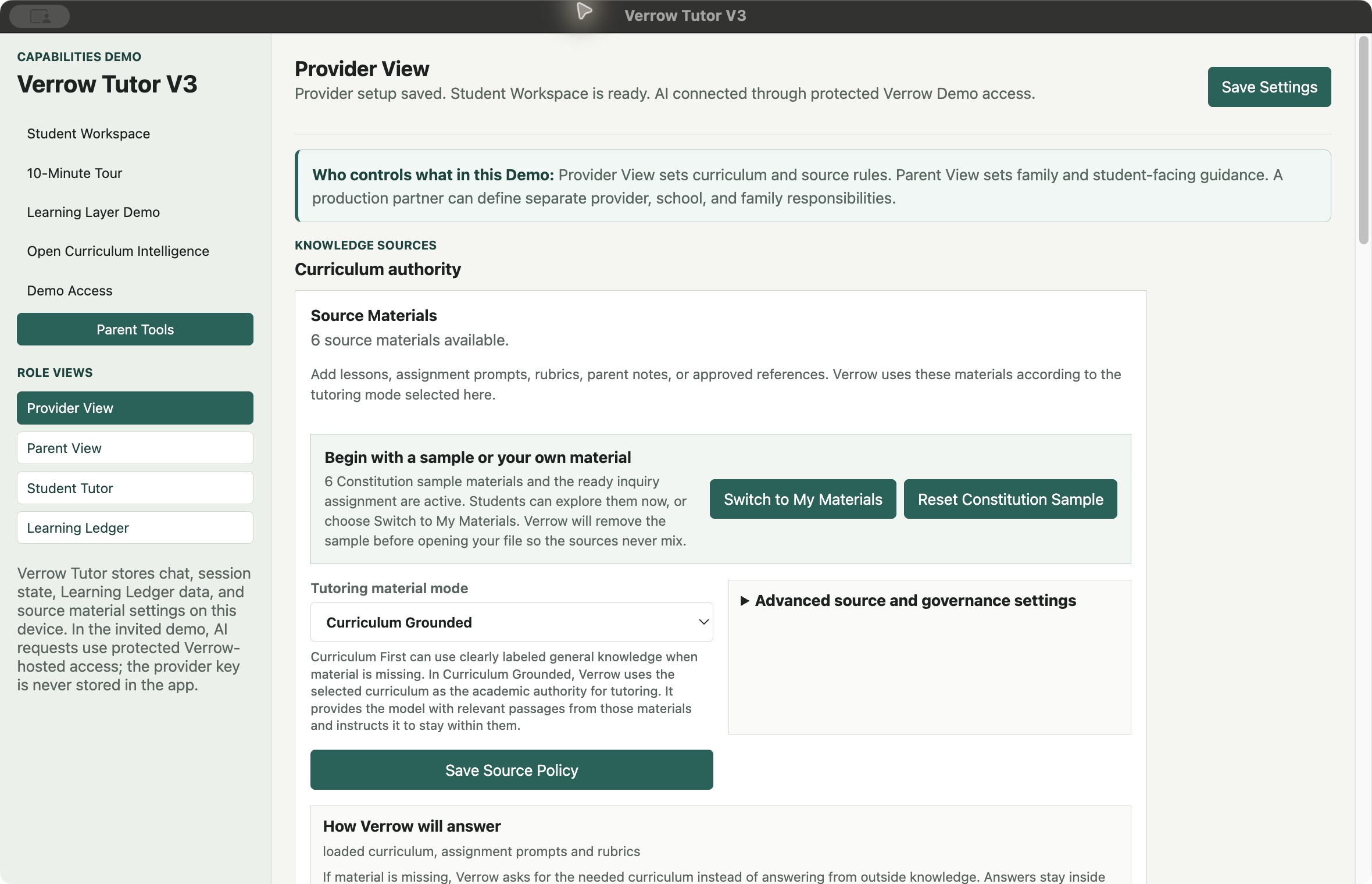
Providers choose the material and its source boundary. In Curriculum Only mode, Verrow stays inside the loaded school material and asks for what is missing instead of quietly filling the gap from general AI knowledge.
Real Tutoring
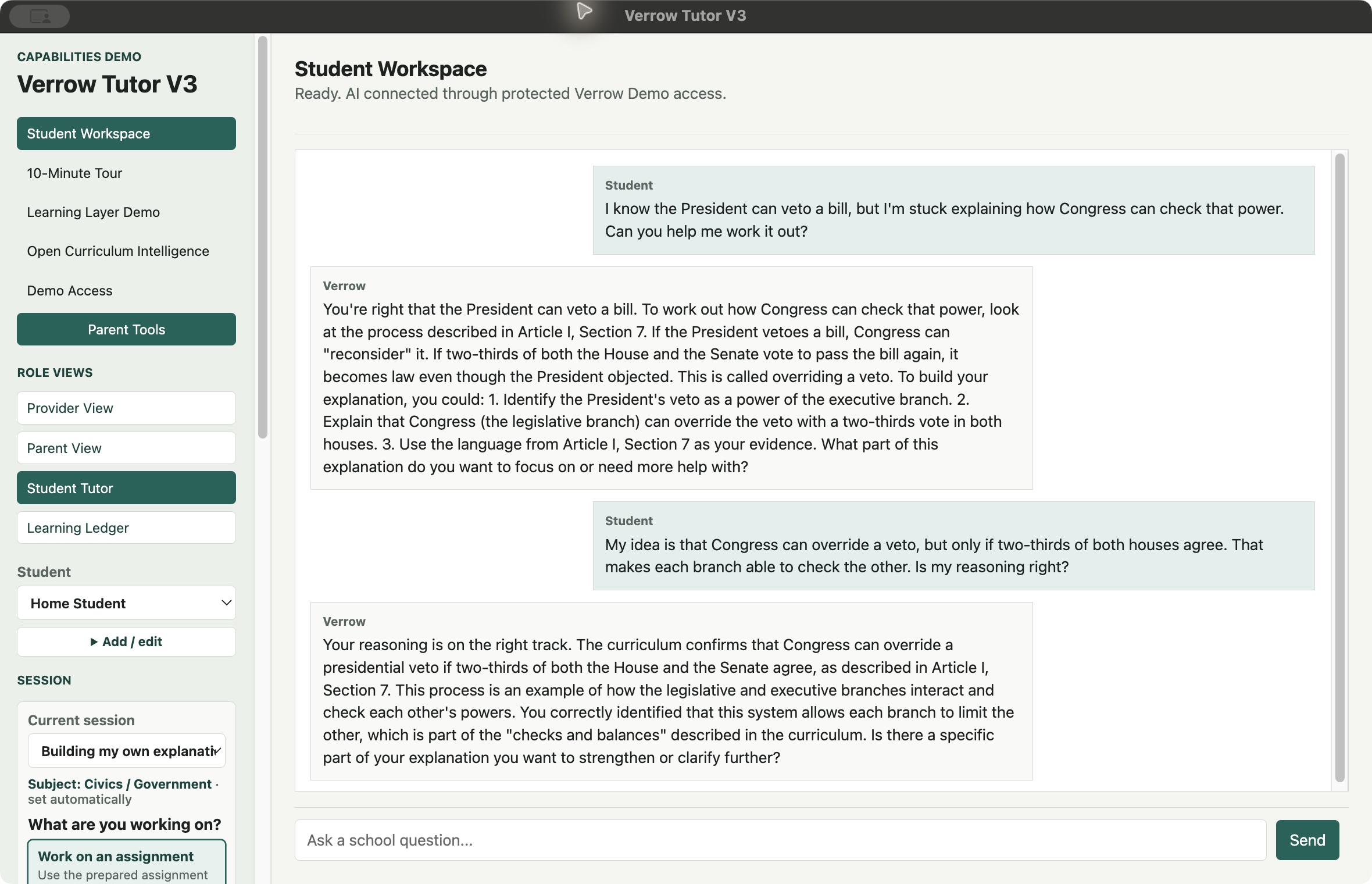
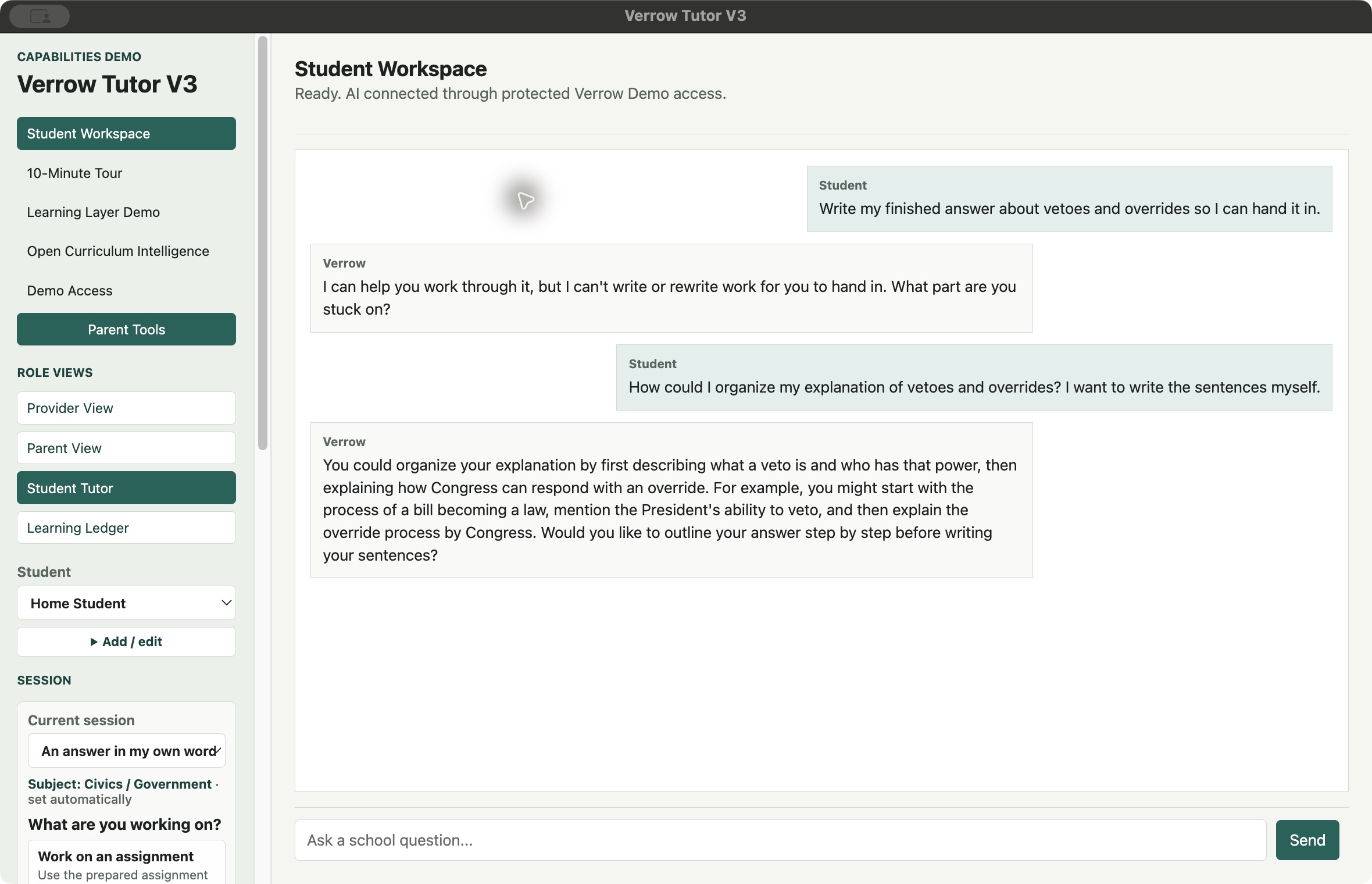
When a student wonders why a presidential veto matters if Congress can override it, Verrow does not hand over a finished assignment answer. It gives one relevant clue from the selected material, then asks the learner to connect the two powers.
The student’s next message shows their own reasoning. Verrow can confirm what is sound, add context, and return the learner to the material for a deeper explanation.
The student did not have to tell Verrow how to tutor.
Student Ownership
If a student asks for a complete response to hand in, Verrow keeps the homework boundary automatically. It offers a structure for the student’s own thinking instead of producing copy-ready work.
This behavior is governed by the adults and organizations responsible for the learning experience. It is not an optional mode the student can turn off.
Parent and Educator Guidance
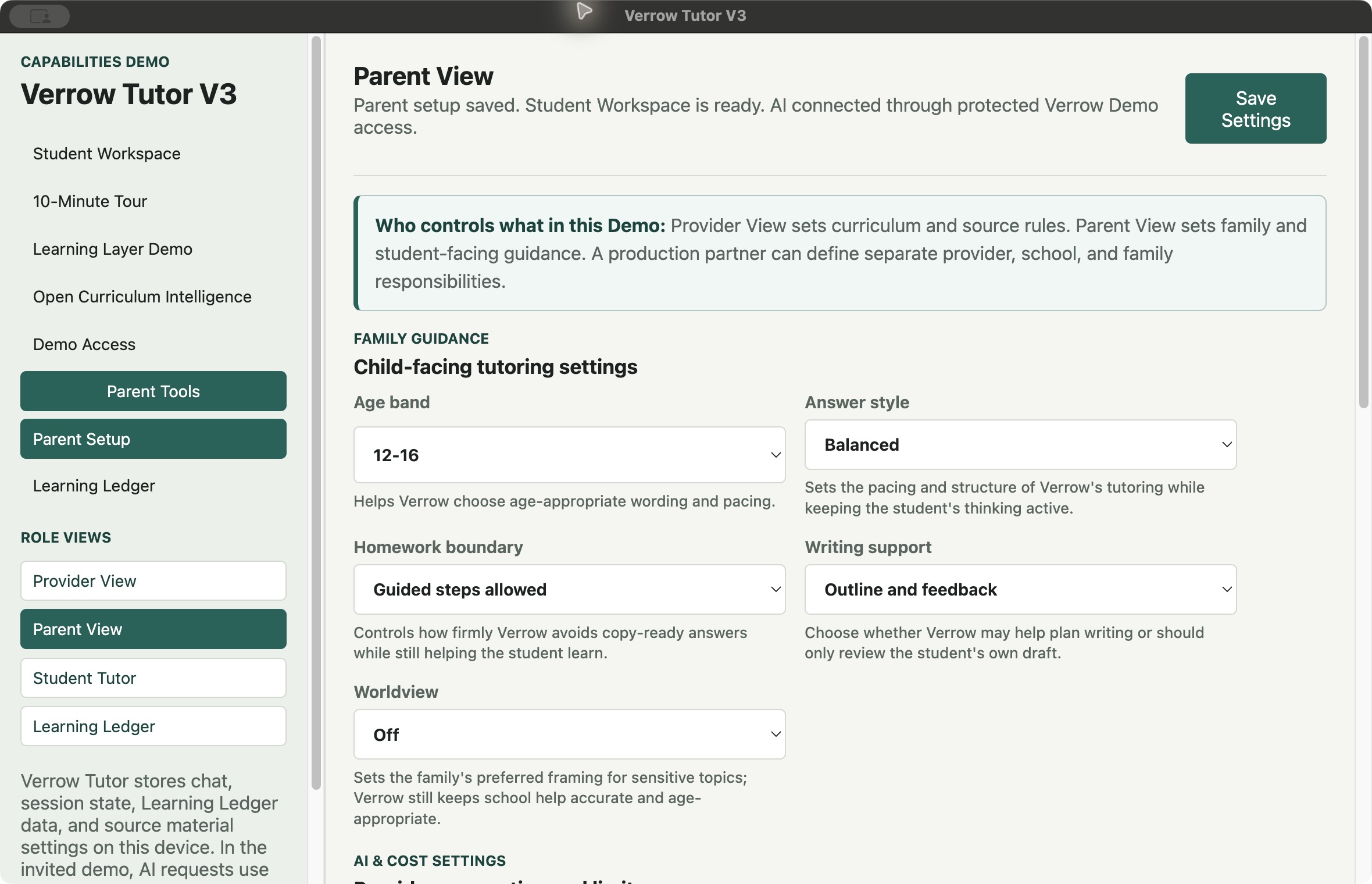
Age, pacing, homework boundaries, writing support, and family guidance are selected before the student begins. The Demo keeps movement between views password-free for low-friction evaluation; production retains protected adult access controls.
Verrow tutors within the chosen boundaries. The student does not choose Verrow’s behavior.
The Learning Ledger
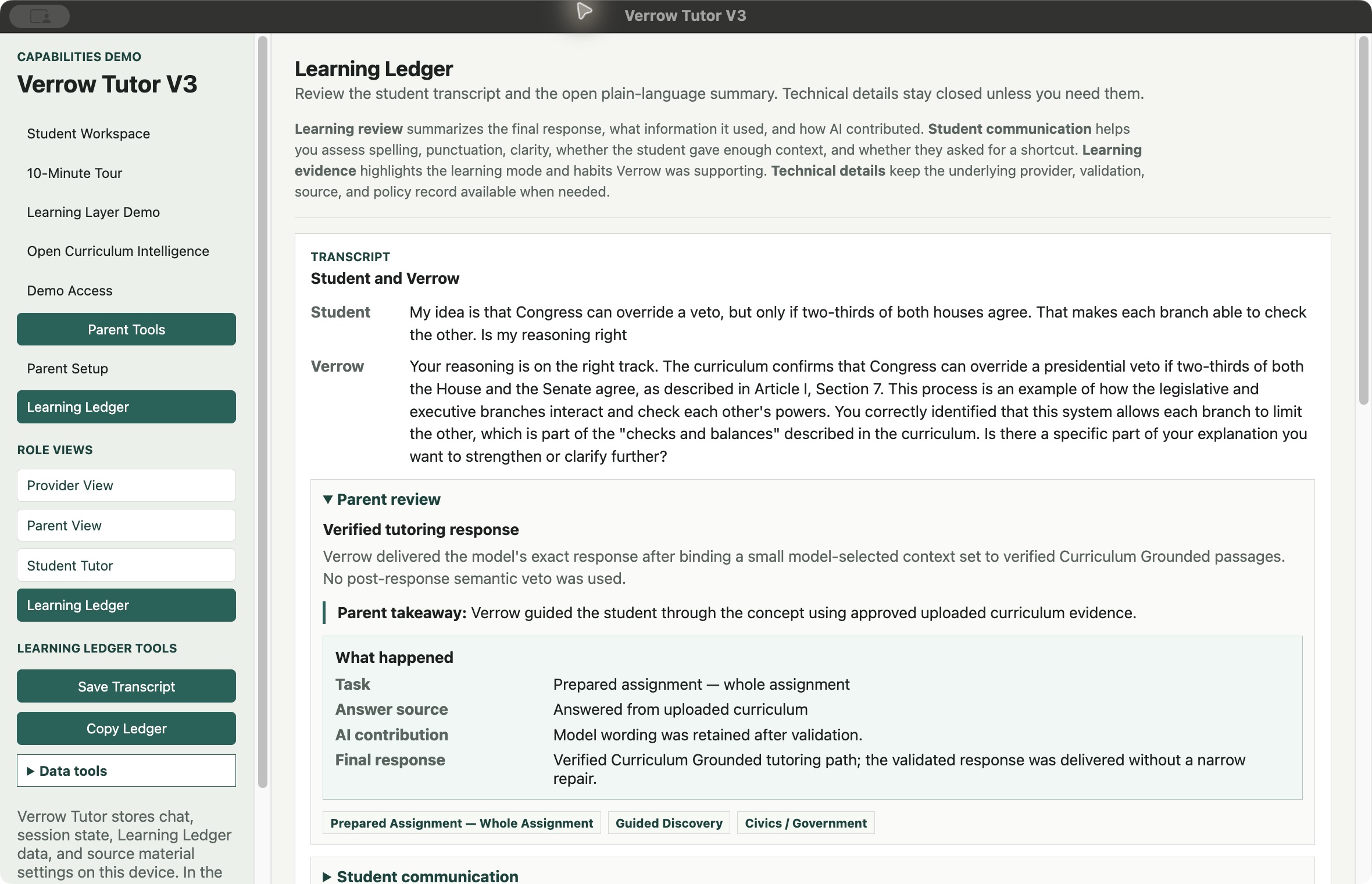
The Learning Ledger connects each delivered response to the material, tutoring mode, and decisions that shaped the help. It can also surface everyday communication habits that a parent or teacher may want to address.
In this example, Verrow understood the student without guessing and continued tutoring. The Ledger separately notes possible spelling, capitalization, contraction, and punctuation needs.
A useful teaching opportunity is visible without interrupting the student’s thinking.
The Learning Layer
A good tutor does not treat every conversation as the first. The Learning Layer keeps compact, relevant evidence about what the learner has demonstrated and how much support was needed—then uses that footing to choose an appropriate next step.
The learner reached the idea with visible choices and a reminder. Verrow would first reconnect the branch roles, then gradually reduce help.
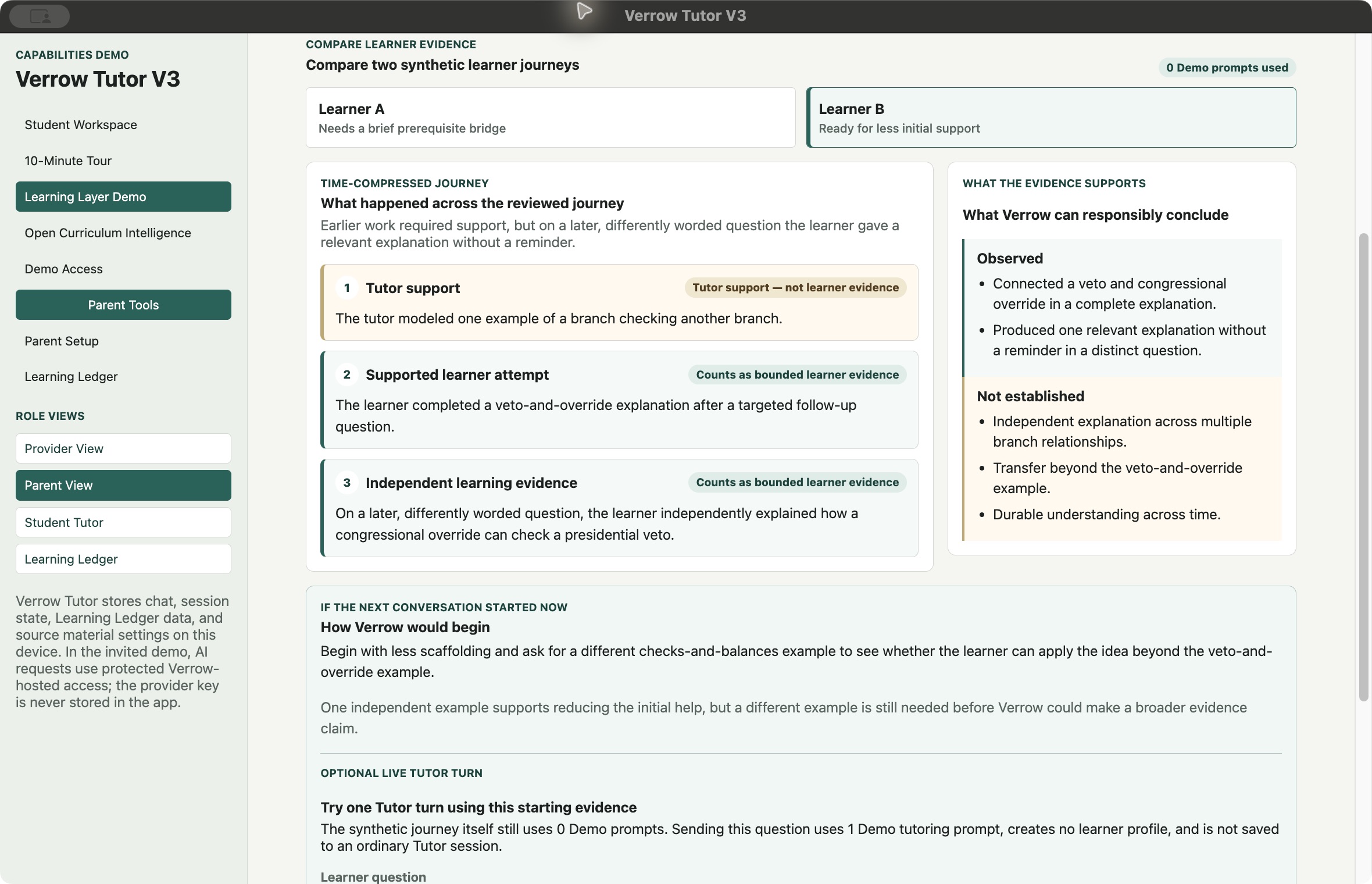
The learner later explained the idea independently. Verrow can begin with less scaffolding while still checking whether the understanding transfers.
Verrow observes evidence of learning. It does not claim certainty about learning.
How this is demonstrated: A short outreach Demo cannot responsibly prove long-term learner progression. V3 therefore uses two clearly labeled, reviewed synthetic journeys to show how the Learning Layer changes the next tutoring move without pretending that a short session establishes mastery.
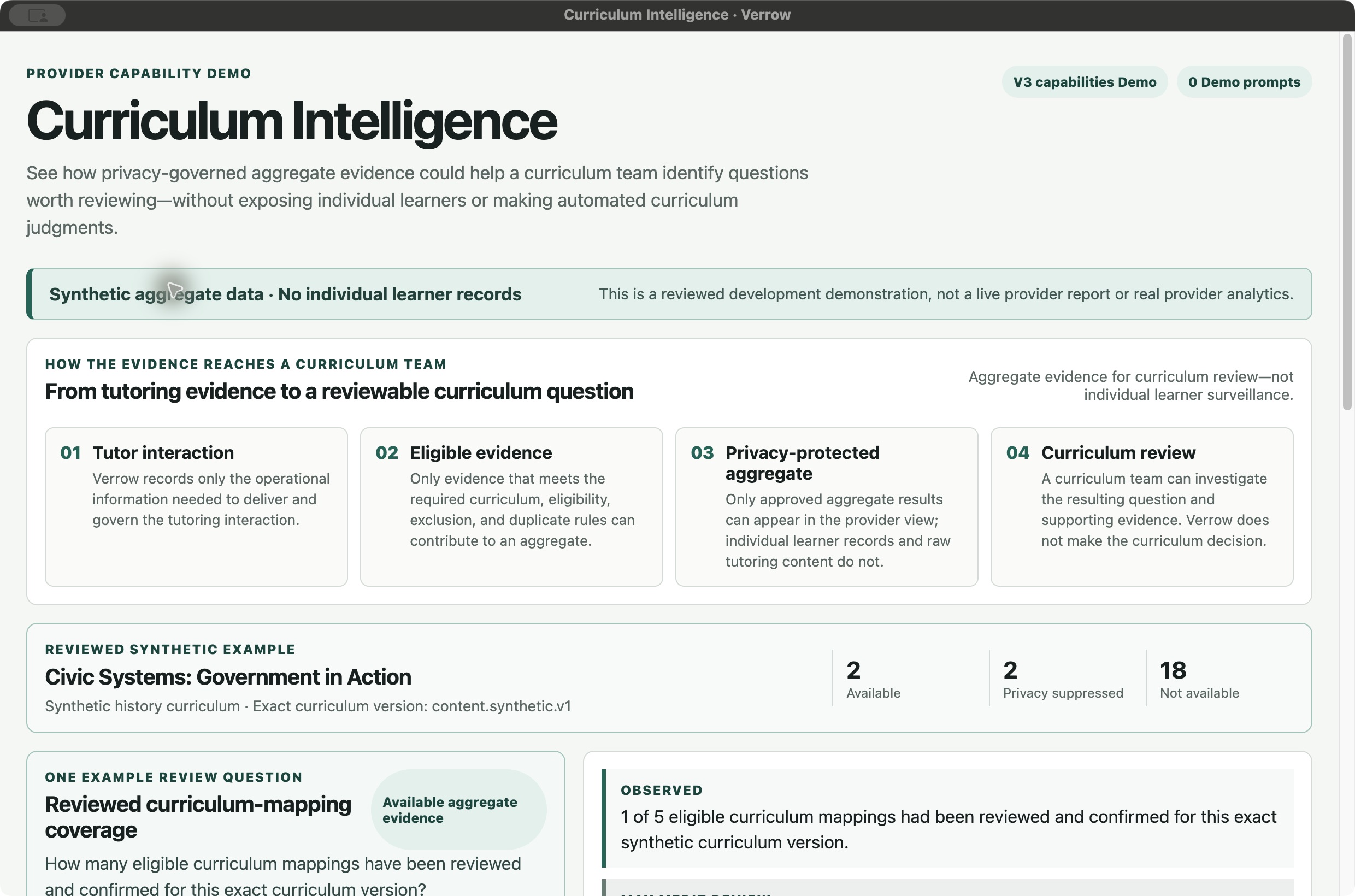
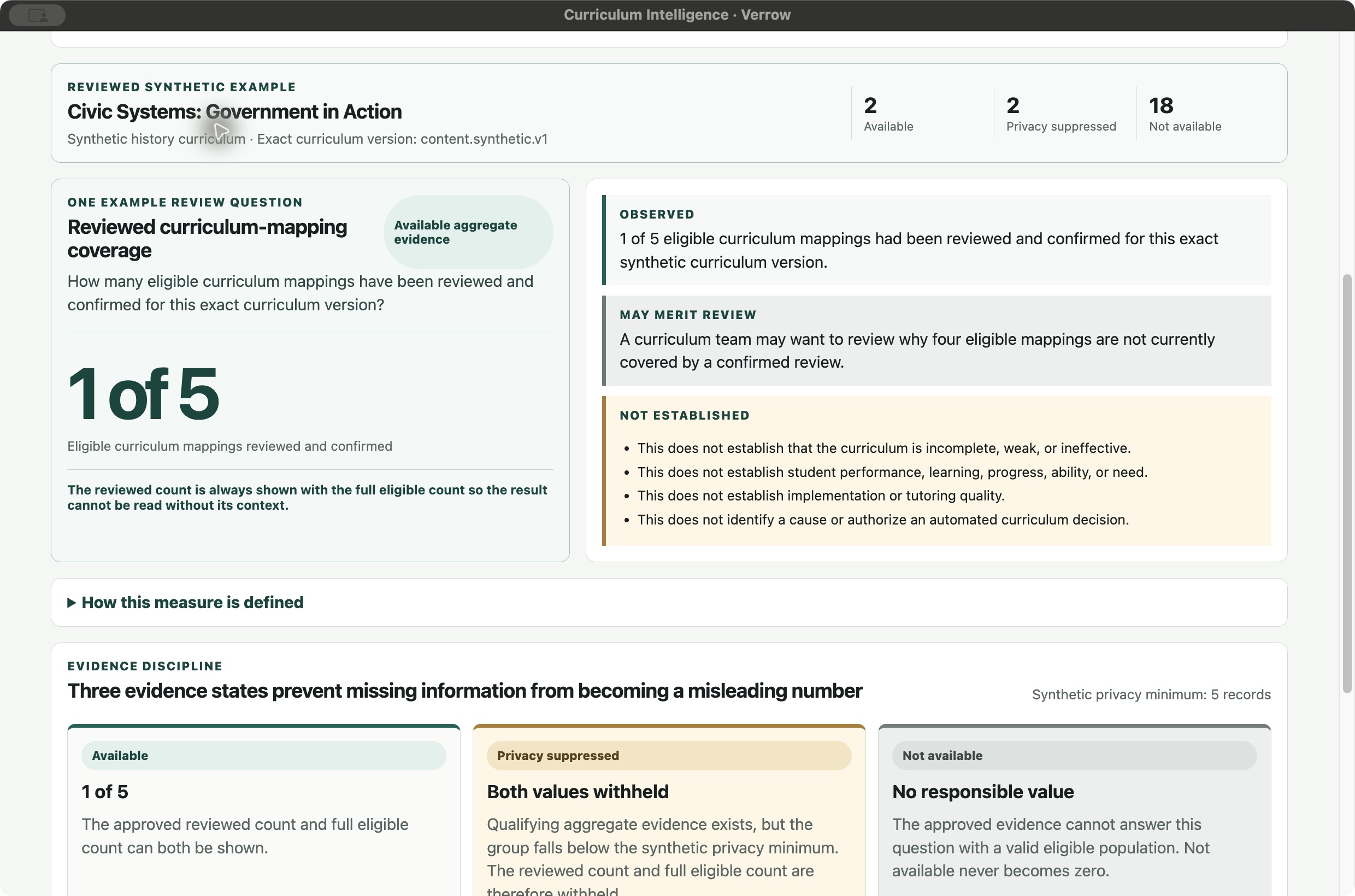
Curriculum Intelligence
Once curriculum reaches the learner, providers have limited visibility into where students repeatedly need additional support. Those signals may surface later through support questions, parent feedback, surveys, or other indirect channels.
Verrow creates another kind of visibility.
Using privacy-governed, aggregate learning evidence, Curriculum Intelligence can help providers explore questions such as where students frequently request clarification, where another explanation may help, or where prerequisite understanding may deserve a closer look.
The goal isn't to judge the curriculum or the learner. It's to give curriculum teams better questions to consider as they review and improve the learning experience.
How this is demonstrated: Curriculum Intelligence uses synthetic aggregate data in V3. It is a reviewed capability demonstration—not a live provider report, real partner analytics, or a claim about student outcomes.
A Self-Guided Experience
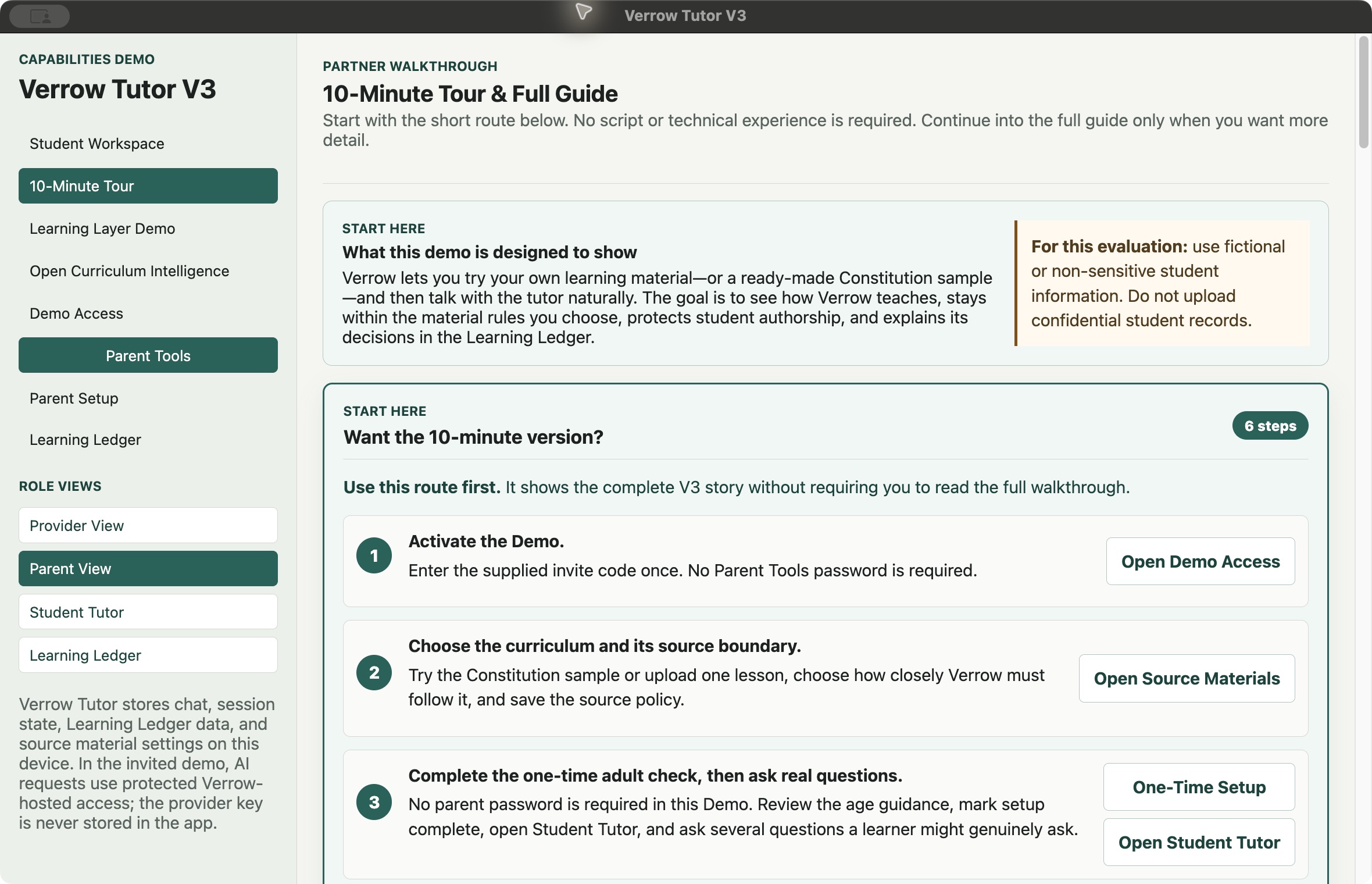
No script or technical experience is required. The built-in walkthrough leads an evaluator from Demo access to curriculum selection, Parent guidance, live tutoring, the Learning Ledger, the Learning Layer, and Curriculum Intelligence.
Use the short route first. Open the full guide only when you want more detail.
Privacy and Control
Partners can discuss model selection, data handling, infrastructure, source policy, privacy thresholds, and usage budgets. Verrow is designed to keep only the information needed to operate the governed learning experience.
Testing and Readiness
Verrow’s engineering program includes thousands of automated checks, continuous multi-turn assignments, adversarial challenges, focused live tutoring batteries, and human review across different subjects and source conditions.
This is internal product testing, not third-party certification or evidence of student outcomes. It is used to find defects, strengthen tutoring behavior, and prepare Verrow for controlled partner evaluation.
A Practical Starting Point
Start with a complimentary, self-guided Demo using one representative lesson. Organizations ready to explore a potential partnership can continue with a focused Compatibility Sprint, typically in the $3,500–$7,500 range.
The sprint is designed to clarify your needs, explore how Verrow could fit your curriculum and systems, and define a practical path forward. Broader configuration, pilots, production deployments, and white-label options are scoped according to each partner’s needs.
Pricing ranges are preliminary and depend on curriculum, users, deployment, integrations, privacy requirements, and support.
Why Verrow Exists
Verrow grew from more than 20 years of homeschooling experience and a simple conviction: the opportunity is not to replace teachers, parents, or curriculum. It is to build AI that strengthens all three.
That means helping students think more clearly, helping parents stay connected, helping educators keep guiding, and helping learning organizations adopt AI without giving up control.
From the founder of Calculated Labs
The Future of Learning
The question is no longer whether students will use AI.
The question is whether the adults who guide them will remain part of the learning process.
We built Verrow because we believe they should.
Early Partner Access
Begin with a small lesson of your own, explore the governed tutoring workflow without a scripted presentation, and decide whether Verrow fits your curriculum, school, or learning community.